
LINKIN PARK: UNSHATTER
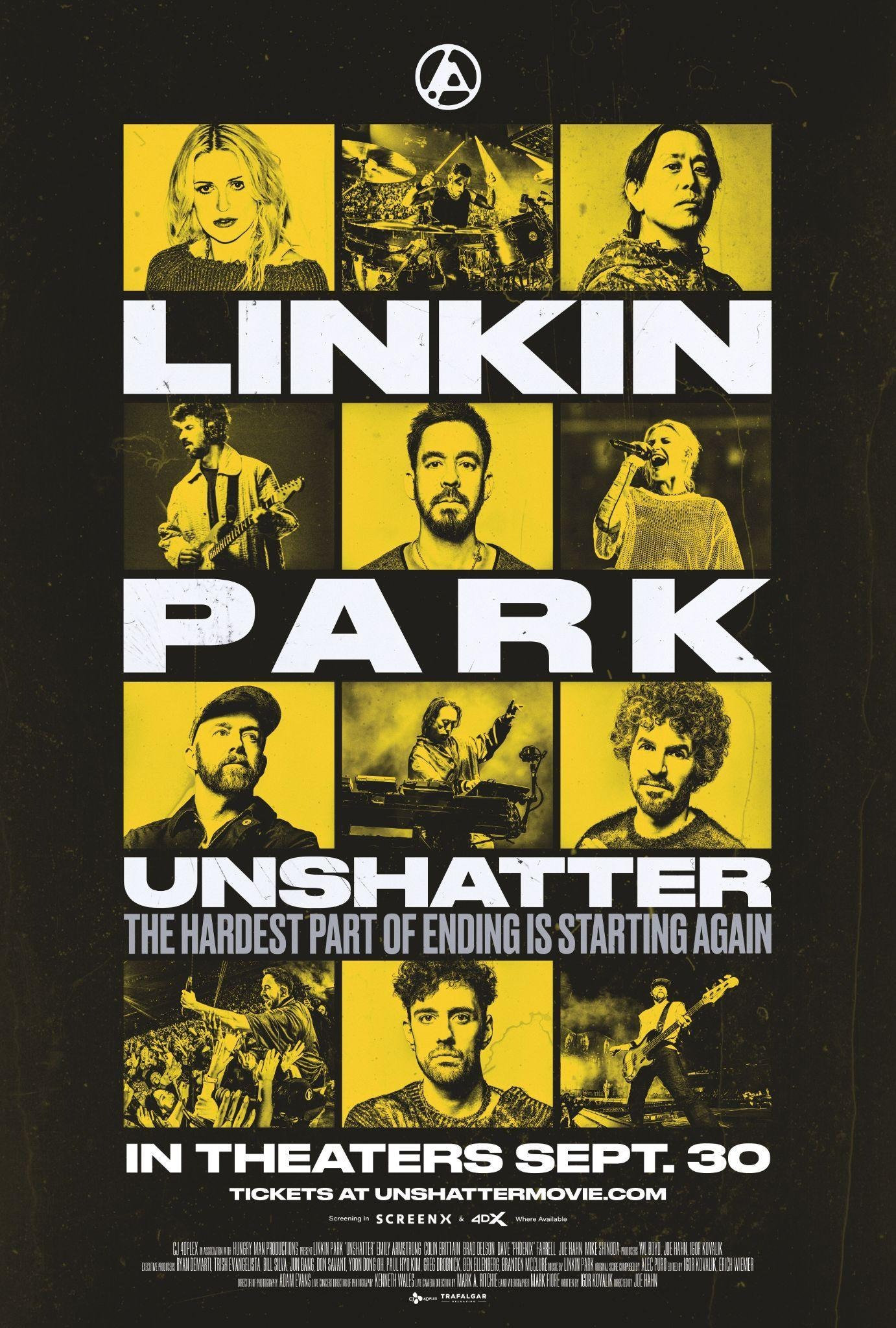
There is an unavoidable question hanging over LINKIN PARK: UNSHATTER: how do you tell the story of a band whose past remains inseparable from its loss, while also making space for a future that did not previously exist?
Moshly was privileged to have an early viewing of the documentary ahead of its limited worldwide cinema run, which begins 30 September.
The upcoming documentary, directed by Linkin Park’s Joe Hahn, appears to take that question seriously. Rather than simply celebrating the band’s history, UNSHATTER focuses on the period surrounding their return to music, beginning with recording sessions in 2022 and leading into the band’s return to the stage and the From Zero era.
That premise gives the film considerably more to work with than a conventional rock documentary. Linkin Park already has an enormous catalogue and a well-established mythology. Another collection of archival footage and concert highlights would be easy enough to assemble. However, the more interesting story is what happened when the band had to decide whether, and perhaps more importantly how, to continue.
The involvement of Joe Hahn as director is both the film’s most intriguing feature and its most obvious complication. His intimate knowledge of the band gives him access that an outside filmmaker could never replicate. At the same time, directing a documentary about your own band inevitably raises questions about perspective. How candid can the film be when the filmmaker is also one of the people whose decisions, experiences and emotions are at the centre of the story?
The arrival of Emily Armstrong (vocals) and Colin Brittain (drums) makes that question even more significant. Their presence represents a new chapter rather than an attempt to recreate the past, and the documentary has an opportunity to explore what that transition actually meant for the people involved. Whether UNSHATTER embraces the uncomfortable parts of that process or settles for a polished account will ultimately determine how revealing it can be.
The film also features Blink-182’s Mark Hoppus, who was among the first people outside the band to hear some of the new material in the studio, before Linkin Park had even publicly announced that Emily Armstrong would be joining the band. That detail offers an intriguing glimpse into just how early the new chapter was taking shape, and how much of the process existed privately before the world was introduced to From Zero.
The emphasis on studio footage is particularly promising. Linkin Park’s most compelling stories have often involved experimentation and a willingness to push beyond whatever sound audiences expected from them. Seeing that process unfold, hearing the songs take shape and watching the members work through the uncertainty of creating something new, proved considerably more revealing than another collection of stadium performances.
Those performances nevertheless form an important part of the theatrical experience. The São Paulo material provides the scale and release that counterbalance the documentary’s more personal moments, showing what the band’s decision to return ultimately became when it was placed in front of thousands of people.
UNSHATTER therefore arrives with something to prove. It isn't simply documenting Linkin Park’s comeback; it is documenting the difficult act of becoming a different version of the band without abandoning everything that made the original meaningful.
At its best, the film is an honest account of a band confronting an impossible reality and the choices that followed. It doesn't pretend there was an easy path forward, nor does it hide the possibility of failure. Instead, UNSHATTER records Linkin Park attempting to build something again from the ground up, without knowing whether it would work and without being afraid to try.